Published on
Updated on
Hooked Rugs in Missouri
On exhibit at the Museum of Art & Archaeology, opening April 25, 2026
Thanks to artists, practitioners, and scholars like Mary Collins Barile, Boonville, Mo., the legacy of traditional hooked rugs has been practiced, passed on, and documented. Missouri Folk Arts thanks Dr. Barile for her significant input on this exhibit, particularly in the interpretative text. Her book Hooked Rugs of the Midwest: A Handcrafted History is a valuable and accessible read to learn more about this dynamic tradition’s roots and ongoing practice in our region.
Three rug hookers are featured in Folk Arts in Bloom: Georgia Adams (Cowgill, Mo.); Christina Edholm (Columbia, Mo.); and Dulcy Stewart (Springfield, Mo.).
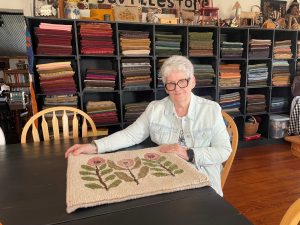
Georgeville Store, with her finished rug, The Garden,
in 2026. Photo credit: Lisa L. Higgins
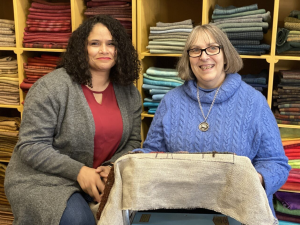
Collins Barile pose with linen on a hooking
frame in 2023.
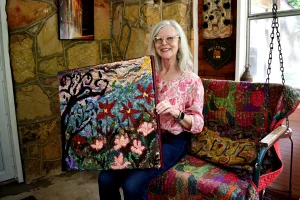
finished floral hooked rugs in 2023.
Photo credit: Kaitlyn McConnell, Ozarks Alive!
From the exhibit interpretive text:
Hooked rugs were established as a craft in New England and the Canadian Maritime provinces by the 1840s, with the tradition moving westward with emigration. Early rugs often had a naïve look, with odd proportions and simple patterns but all showed great affection for their subject. The rug makers’ designs were rambunctious, lively, and colorful, with no artistic rules other than those imposed by the rug maker’s own creative spirit.
Hooked rug makers created these utilitarian objects for the home’s floors and hearths. “Hookers” adapted the form and process to their households’ needs while reflecting their communities’ emerging or established aesthetics.
The process of hooking rugs was, and is, a simple one. A pattern is drawn on a woven backing such as burlap, linen, or cotton that is then stretched over a frame to hold the material taut. Following the pattern, the rug hooker uses a handled tool to pull a fabric strip through the backing, from bottom to top, so that loops line up on the surface, creating the pattern with fabric strips. Once the hooker completes the pattern, the rug’s edges are bound before it is ready for the floor, or the wall.
As early as the 1850s, local Missouri agricultural fairs listed homemade rugs in their premium books, referring to tradition as “pulled rugs” and “Betsy Ross rugs.” The Civil War, unfortunately, left a gap in the story of Missouri rugs, but rug hooking regained popularity in the 1870s as women (and some men) found more leisure time. Newspapers published how-to articles about the craft. Missouri department stores sponsored classes, sold materials, and encouraged the growth of the tradition. The Ozarks emerged as a hub of rug making, both as a hobby and as a way for women to earn extra money through sales to wholesalers and collectors.
Today, Missouri rug hookers continue to share their passions for color and community, participating in gallery shows, the State Fair, guilds, and social “hook-ins” throughout the state.
Sponsors
Folk Arts in Bloom was curated from documentation gathered and relationships established during regional artist surveys from 2022 – 2026 as part of the Show Me Folk Initiative. Show Me Folk is made possible thanks to a Folk Arts Partnership Grant via the National Endowment for the Arts and a Partnership Grant via the Missouri Arts Council. As always, Missouri Folk Arts programming is made possible with the support of the Museum of Art & Archaeology in the Mizzou College of Arts & Science. Special thanks to Banjo Creative for the dynamic graphic design as well as Museum Collections Manager Sarah Thomson and Preparator Matt Smith.