Published on
May 27, 2026
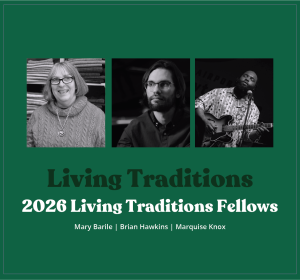
COLUMBIA, MO – The Missouri Folk Arts Program is excited to announce recipients of the 2026 Missouri Living Traditions Fellowship, an award to recognize the artistic excellence and exceptional lifetime achievement of living traditional artists and community scholars in the Show Me State.
For 2026, Missouri Folk Arts recognizes three individuals for their deep-rooted contributions to traditional arts within their vibrant Missouri communities.
Join us as we congratulate Mary Barile (Boonville), Brian Hawkins (Harrisonville), and Marquise Knox (Bowling Green). Fellows will participate in public events and contribute to recorded oral histories that document their achievements. Stay tuned to Missouri Folk Arts Program’s social media to learn about upcoming special events in the coming weeks to honor Dr. Barile, Mr. Hawkins, and Mr. Knox.
Mary Barile
Traditional Rug Hooker and Documentarian, Boonville, MO
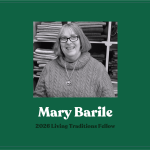
Mary Barile learned rug hooking as a child in upstate New York beside her mother and a circle of friends who gathered socially to hook rugs. In 2001, Barile relocated to Missouri, and for the last twenty-five years, she has practiced, mentored, researched, documented, curated, and interpreted the tradition in the Midwest and, particularly, Missouri.
Nominator Tina Edholm writes of her friend and mentor: For more than two decades in Missouri, Mary has demonstrated an exceptional commitment to preserving, teaching, and interpreting the tradition of rug hooking. Her work has transformed how rug hooking is understood and experienced in the state, shifting it from a largely private craft to a publicly recognized and interpreted cultural tradition. Through sustained artistic practice, research, teaching, and advocacy, Mary has ensured that rug hooking in Missouri is not only preserved but actively practiced, taught, and valued within communities across the state.
In a letter of support, Susan Meadows, President of the Big Muddy Rug Hooking Guild, noted that Barile was instrumental is teaching a circle of friends and establishing the guild, which grew from twelve members in 2018 to forty-nine as of 2026. Meadows also wrote: Beyond teaching the craft of rug hooking, Mary soon embarked on a project to research the art of rug hooking here in the Midwest. In 2013, she authored, Hooked Rugs of the Midwest. With this project, she did extensive research and interviewed many long-time rug hookers who shared local history of their craft. Mary is now working on a new book that focuses specifically on the history and origins of rug hooking here in Missouri. Her ability to dive into and uncover articles and snippets of information for this history amazes me.
Brian Hawkins
Documentarian of Missouri French Traditions, Harrisonville, MO
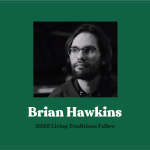
Brian Hawkins is a visual artist, animated filmmaker, ragtime musician, and documentarian, who relishes delving into archival materials to share stories with more widely. Over the last decade, for instance, Hawkins has explored the Missouri French region in and near Old Mines, Missouri, in person and from primary resources held at The State Historical Society of Missouri and other depositories. From that research, he turned to another expertise–cut paper animation–to share Missouri French traditional tunes, folk tales, and personal experience stories.
As his nominator Natalie Villmer wrote: When I was growing up in the Old Mines region, my grandfather would tell me and my siblings many of the folktales that had been passed down in our community for hundreds of years. He would translate them into English telling us that they sounded much better in French. Brian is working to make sure that these stories do not die out, and with his animations, he is working to make them accessible in their original language.
In a letter of support from Kent Bone dit Beaulne, he noted not only Hawkins’s passion but his attention to details: Brian is making a different kind of project. He is more interested in the history, old folktales, and songs. He has found recordings of people from my grandparents’ generation telling stories in French, and he has been making them into animations. This is a way of keeping the tales alive. He can work in a lot of music and historical details into the films. At first, I wondered why anybody would need to know what color people painted the trim on their houses or the types of oil lamps the miners used. It made sense when I saw the paintings Brian was making for his animations . . . The folktales Brian has been working with in his film have not been told for a long time, and now they are being shared in new ways. He is doing his part to keep that tradition alive.
Marquise Knox
Blues Musician, Educator, and Advocate, Bowling Green, MO
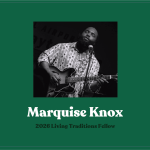
Marquise Knox came to the Blues tradition early with the support of family, especially his grandmother Lilly Mae and his great uncle Clifford. As early as eleven years old, Knox was welcomed to jam with local legends. He enjoyed and cultivated relationships with a who’s who of Blues greats from St. Louis to Grenada, MS. Since that time, Knox has grown immensely as a musician and as staunch advocate for the distinct St. Louis tradition.
Nominator Lamont Jack Pearley writes of Marquise Knox: [he] is a powerful embodiment of the living tradition of Missouri Blues. His work is grounded in African American cultural knowledge, spiritual depth, oral tradition, social memory, and a sustained relationship to the Black experience in Missouri. He does not approach the Blues as a static genre or entertainment form alone. Rather, he understands and practices it as a living cultural language—one that carries history, struggle, testimony, humor, critique, faith, and survival. This understanding makes him not only an accomplished performer, but also a traditional arts practitioner in the fullest sense of the term.
In a letter of support, mentee Jamie E. Hudson explains that Mr. Knox has been an excellent guide for the past three years. He has shown excellence in leadership and knowledge of his traditional craft: blues music. I have observed Mr. Knox as he has educated crowds and classrooms on the history, importance, and traditions of blues music, especially its rich history in St. Louis.
Marquise Knox is a decorated storyteller and blues musician; however, his reach is much farther than the stage. He aided in the creation of the Loop in Motion event which hired and highlighted upcoming St. Louis artists. He was able to take St. Louis blues music on tour with world renowned artist ZZ Top during their 50th anniversary tour. In addition, Marquise has shown his dedication to the improvement of his community by participating in the Blues in the Schools program in which he created a short and powerful curriculum to help pass along musical traditions and knowledge to at-risk youth.
*****************************************************************************************
Living Traditions Fellowships are modeled on National Heritage Fellowships presented since 1982 by the National Endowment for the Arts. For Missouri’s fellowship, Missouri Folk Arts Program uses the NEA’s definition of folk and traditional arts:
The folk and traditional arts, which include crafts, dance, music, oral traditions, visual arts, and others, are those that are learned as part of the cultural life of a community whose members share a common ethnic heritage, cultural mores, language, religion, occupation, or geographic region. These traditions are shaped by the aesthetics and values of a shared culture and are passed from generation to generation, most often within family and community through observation, conversation, and practice.
This project is made possible through grant funds awarded by the National Endowment for the Arts (NEA) and the Missouri Arts Council, with support from the Museum of Art and Archaeology at the University of Missouri.
About the Missouri Folk Arts Program
In the mid-1980s, the Missouri Arts Council (MAC) and University of Missouri formed a partnership with National Endowment for the Arts grants that established a statewide folk arts program to support traditional artists, their communities, and organizations. With ongoing grants from the NEA and MAC, the Missouri Folk Arts Program continues to build understanding by documenting, sustaining, and sharing our state’s living folk arts and folklife in collaboration with Missouri’s citizens. Since 1993, Missouri Folk Arts Program has been anchored at the University’s Museum of Art and Archaeology.
For more information on the Missouri Folk Arts Program, contact Lisa Higgins, director, mofolkarts@missouri.edu